- AI infrastructure
- Enterprise decisions
Big Tech's AI capital expenditure challenge extends beyond the sheer volume of investment. It hinges on the ability to synchronize decision-making across an AI infrastructure stack that operates on vastly different planning cycles.
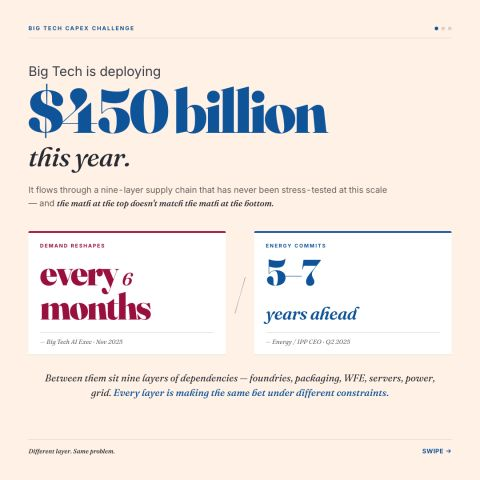
This year, approximately $450 billion is being invested in AI infrastructure by major tech companies. This capital traverses a complex supply chain that encompasses chips, foundries, advanced packaging, wafer fabrication equipment, servers, data centers, power procurement, and the grid.
The core issue lies in the timing discrepancies among these layers. AI demand can fluctuate every six months, while energy and grid commitments may require five to seven years of planning. Other components, such as packaging capacity, GPU supply, equipment slots, and data center construction, fall somewhere in between these timelines.
This misalignment presents a significant operational challenge. Companies must not only forecast demand but also make compatible investment decisions across layers that face varying constraints, lead times, and risks.
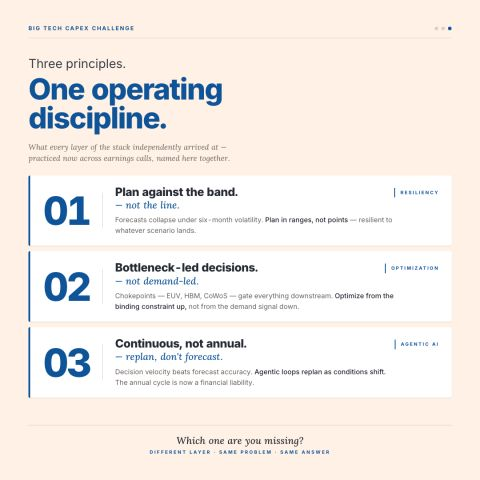
A clear pattern is emerging across the value chain. Leaders must plan for multiple scenarios rather than relying on a single forecast. Decisions should be made from the binding bottleneck rather than solely from demand signals. Continuous replanning is essential as conditions evolve, moving away from traditional annual planning cycles.
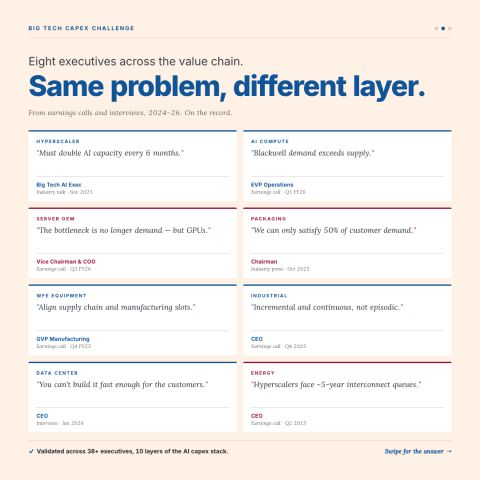
Thus, the AI infrastructure buildout is evolving into a coordination challenge as much as a capital challenge. Hyperscalers feel this pressure as capacity demand, semiconductor companies as allocation pressure, packaging suppliers as throughput pressure, utilities as interconnect pressure, and data center operators as execution pressure.
Each layer perceives the problem differently, yet they all respond to the same fundamental constraint. The next competitive edge in AI infrastructure may not stem from the highest spending but rather from the ability to navigate uncertainty effectively.
Which layer of the AI capital expenditure stack do you believe will encounter the most significant bottleneck first