- AI infrastructure
- Semiconductors
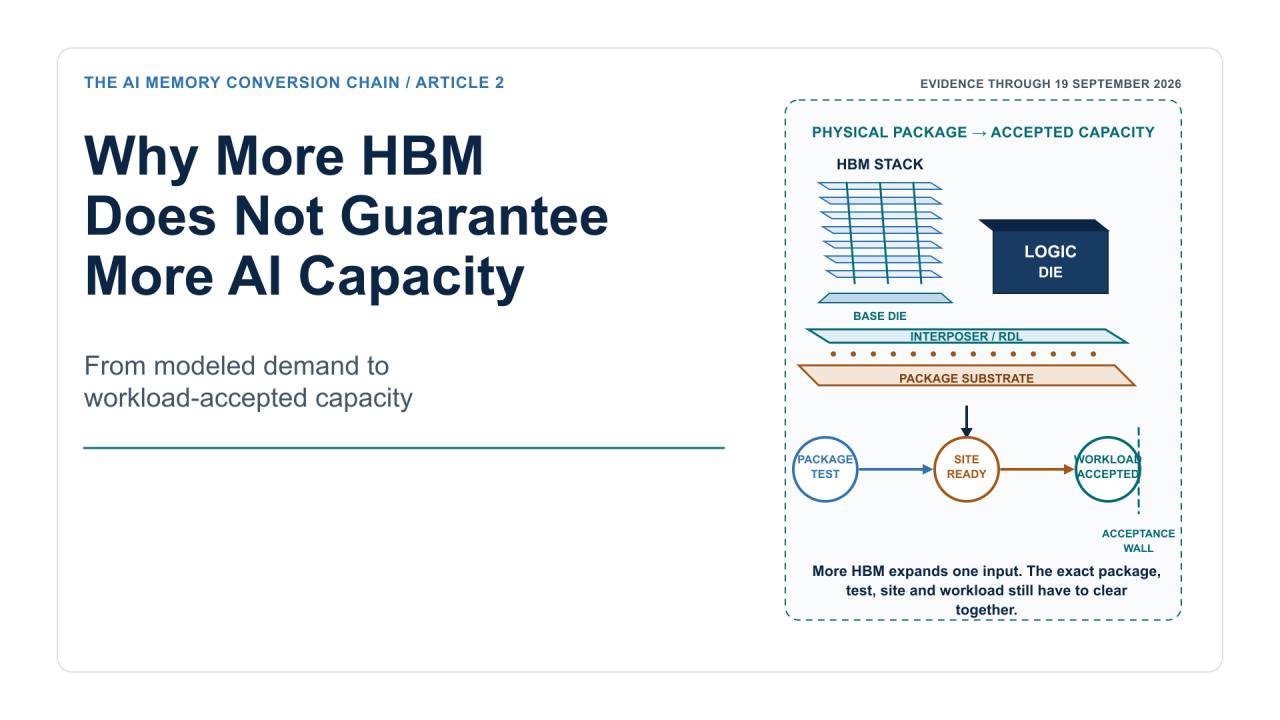
From modeled HBM demand to workload-accepted capacity and the economics of asynchronous supply
ARTICLE 2 OF 2
Link to article 1: https://www.linkedin.com/pulse/what-turns-ai-growth-hbm-demand-ujjal-dutta-x7k4c/
1 From demand to accepted capacity
More HBM does not automatically create more AI capacity.
Orders, revenue and backlog measure commercial activity. Workload-accepted capacity requires the exact configuration to clear memory, accelerator logic, advanced packaging, package test, platform qualification, and site plus workload acceptance by the required date.
Until that happens, the commitment remains exposure.
Demand creates a requirement. Alignment creates capacity. Acceptance creates a productive asset.
Dell's fiscal Q2 2027 reported $60.9 billion in AI-server orders, $16.4 billion in AI-server revenue and a $95 billion ending backlog.[1] Those figures belong to the commercial ledger. HBM is counted in bits, accelerators in packages, AI infrastructure in dollars, and customer value in accepted workloads. Each unit measures a different state.
Article 1 ended by asking which gate binds next.[2] The answer depends on the workload and configuration.
Article 1 translated qualified goodput into a modeled gross package requirement after deducting eligible survivors once. Article 2 starts at that requirement and follows it through the six gates to accepted capacity, commercial exposure and return.
2 The commercial and physical ledgers measure different states
The three Dell measures share a currency while describing different populations and dates. Orders and revenue are period flows; backlog is a balance at 31 July 2026. Revenue can contain earlier order cohorts, while system-level acceptance records supply the workload denominator. Dividing one dollar measure by another would create a false conversion rate.
Dell describes product backlog as unfulfilled manufacturing orders. Those orders enter remaining performance obligations only to the extent that they are non-cancelable.[3] The legal and accounting states are therefore relevant—but distinct from physical completion.
The Dell example shows why four physical states need their own labels:
· QUALIFIED HBM STACK — a tested memory product.
· COMPATIBLE ACCELERATOR PACKAGE — the correct memory, accelerator logic and integration route.
· INSTALLED AND COMMISSIONED SYSTEM — physically integrated and energized, with workload acceptance still ahead.
· WORKLOAD-ACCEPTED SYSTEM — the complete platform has also passed its software, network, performance, quality and governance tests.
The final state creates workload-accepted capacity. To compare owned systems, cloud instances and allocated services consistently, normalize qualifying units into an accepted equivalent for one workload, exact configuration, site and cutoff.
The commercial ledger records forecasts, reservations, capacity agreements, purchase orders, shipments and payments. The physical ledger records wafers, known-good die, qualified stacks, compatible packages, tested nodes, commissioned racks and accepted services. Each ledger answers a different question.
The economic ledger moves on a third clock: contract pricing, utilization, depreciation, margin and return on capital can lag both commercial commitment and physical supply relief.
Reconcile them with one shared dimensional key:
workload lane | exact configuration or SKU | quantity and unit | site | required date | commercial or contract state | regulatory eligibility where material | acceptance criterion
That key reveals two frequent mismatches: procurement may cover the wrong configuration, while physical output may lack allocation, commercial access or workload eligibility.
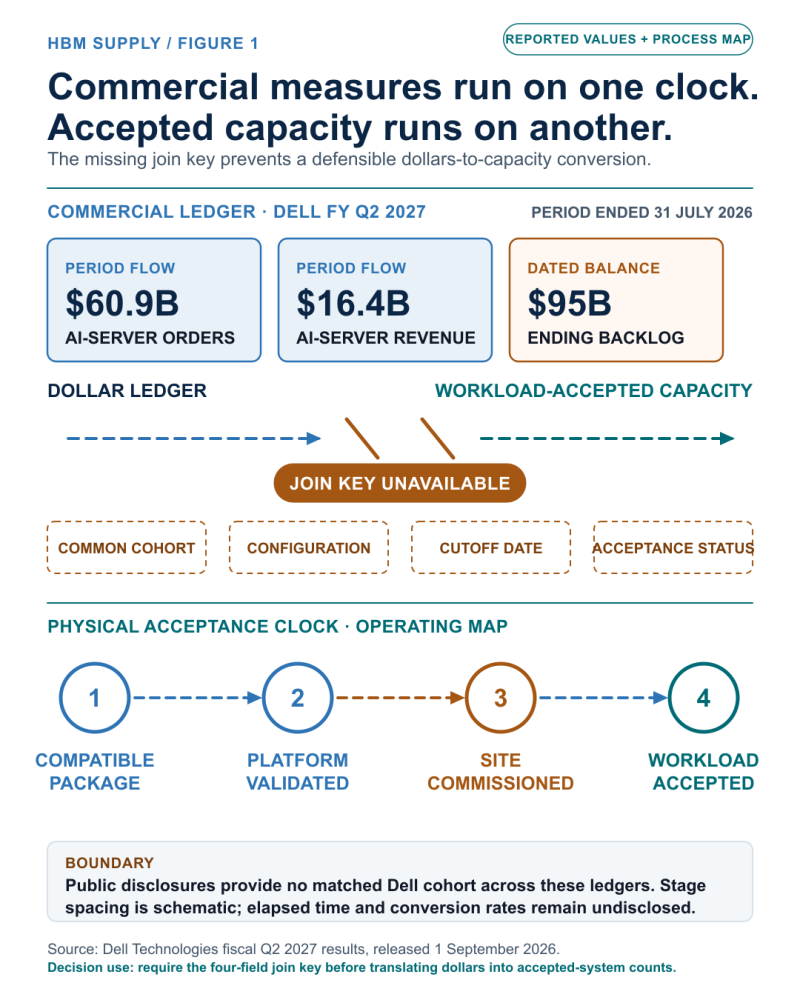
Identify the missing join between reported commercial measures and workload-accepted capacity, then reconcile cohort, configuration and cutoff.
3 The shared manufacturing, test and deployment spine
Where does modeled demand first meet physical resistance? Across a shared chain from wafer preparation and stacking to test, package integration, platform qualification and site acceptance. The binding stage changes with the required configuration.
Wafer preparation and stacking: The shared route begins with electronic-grade polysilicon, single-crystal ingot growth, wafer slicing, polishing and inspection. SUMCO describes epitaxy as specification-dependent.[4]
The HBM-specific route fabricates DRAM and base-die wafers, forms through-silicon vias and interconnects, identifies known-good die, then thins, aligns and bonds those dies into stacks. Micron describes tested dies moving through stack assembly and final testing; SK hynix highlights thin-die warpage control and protective materials.[5][6] Together, the disclosures explain the process while leaving customer-level yield and allocation unquantified.
Test insertions: Testing is a sequence: wafer sort; post-dice known-good-die screening; post-stack electrical and thermal test; final package and reliability screening; board, rack and fabric validation; and workload acceptance. Advantest explains that wafer test leaves post-singulation functionality to a separate insertion involving handling, alignment, cooling and contact.[7] A tester count measures installed tools; usable capacity requires qualified throughput for the exact insertion sequence. Advantest separately describes growing wafer- and package-level test intensity around HBM and AI logic.[8]
Package route: A qualified stack must still meet known-good accelerator logic, the eligible interposer or redistribution-layer route, substrate, assembly and final test. TSMC's portfolio divides CoWoS into distinct routes: CoWoS-S uses a large silicon interposer; CoWoS-R uses a polymer-and-copper redistribution-layer interposer with a 4-micrometre minimum routing pitch; and CoWoS-L embeds local silicon interconnects within an RDL-and-molding route.[9] Each route carries different design rules, tools, materials and qualification evidence.
Mechanical qualification: Route substitution also changes the mechanical problem. One peer-reviewed 72.5 × 70 millimetre fan-out test vehicle with an ASIC and two HBM interfaces found that underfill glass-transition temperature and thermal-expansion behaviour materially affected HBM-corner bending stress from package warpage.[10]
The study measures mechanical behaviour; commercial yield lies beyond its dataset. Its planning relevance is direct: an alternate route may need renewed mechanical, electrical and thermal qualification before it contributes accepted equivalents. The compatible package must then clear integration, site, software and workload acceptance.
For capacity planning, treat announced wafer, HBM, packaging and test capacities as successive, configuration-matched stages. One compatible route that survives every required step by the cutoff contributes accepted equivalents.
The correct physical statement is consequently conservative:
qualified stack ≠ compatible package ≠ installed and commissioned system ≠ workload-accepted system
A layer-count yield exponent would omit known-good-die screening, bonding, rework, test coverage, binning and allocation. Public sources leave those steps unjoined for one customer and period.
Nameplate capacity is what a line can process. Effective capacity is the qualified output that survives the relevant yield, mix, test, allocation and timing losses for the required route.
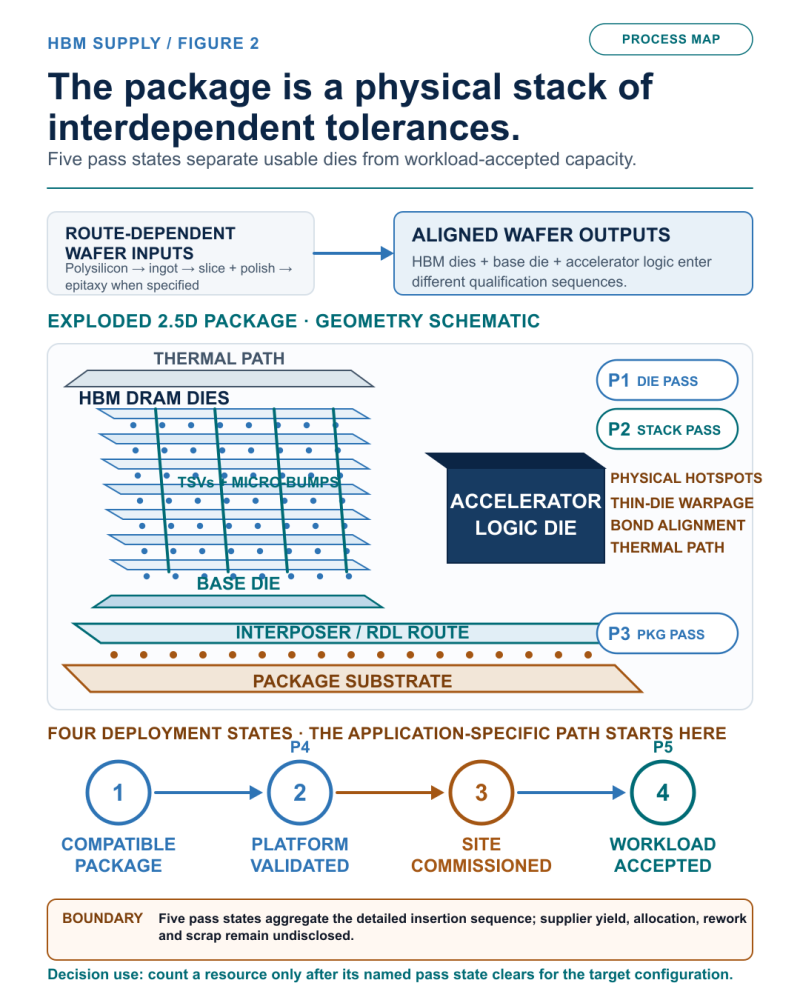
Locate the physical and test stages where a qualified stack can lose eligibility before workload acceptance.
The applications diverge when the workload selects the accelerator-memory configuration, qualification path, sourcing route, deployment environment and economic unit. A captive accelerator can consume HBM while serving a closed cloud pool; an edge product can create offboard HBM demand while using another endpoint memory; and an installed scientific system can still fail topology or validation.
native demand unit → eligible configuration → eligibility exposure → sourcing route → workload acceptance → economic denominator
The shared spine creates potential supply. The workload decides which part of it is eligible.
4 The workload determines which supply counts
Which completed configuration counts for each workload? Figure 3 organizes the answer into five workload cards. Read each row through three questions: What output counts? What must clear? Which eligible supply pool can deliver it by the cutoff?
Application capacity requires a workload-eligible configuration, a supply pool that can furnish it by the cutoff and acceptance by the deadline. Aggregate HBM alone misses those conditions.
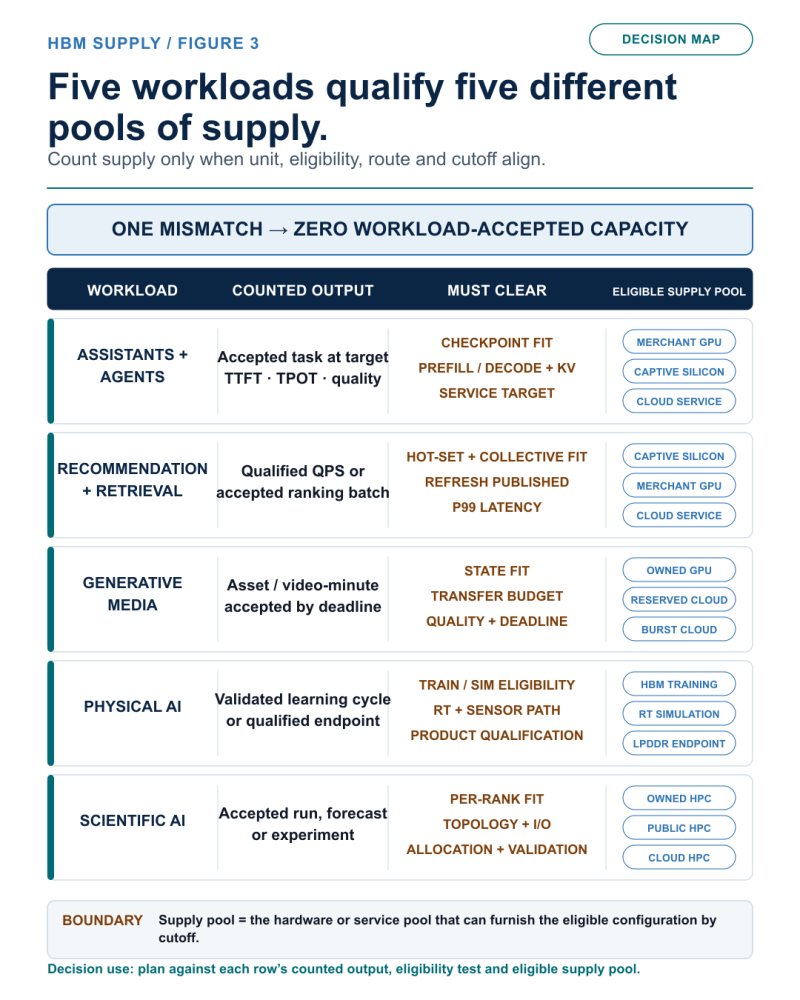
Compare each workload's counted output, eligibility test and eligible supply pool—the hardware or service capacity that can furnish the eligible configuration by the cutoff—before adding capacity.
4.1 Assistants and agents
Eligibility test. Eligible supply fits the model and service state while training, prefill, decode, KV transfer, scheduling and fabric clear the required quality and latency targets.
Meta distinguishes compute-intensive prefill from memory-bandwidth-intensive decode. Model weights and the key-value cache occupy much of inference memory, while active cache grows with context length.[11] NVIDIA Dynamo can place prefill and decode in separate worker pools, but the pools must exchange KV state and remain balanced.[12]
Training eligibility joins model, optimizer state, collectives, checkpoints and software. Inference joins request distributions, concurrency, cache reuse and latency. Weight fit alone is insufficient.
Anthropic said it was using more than one million AWS Trainium2 chips, and AWS documents 96 GiB of HBM per accelerator.[13][14] This captive AWS operating route belongs to service capacity rather than the merchant accelerator pool.
For planning, training closes on a qualified campaign; inference closes on an accepted token or task at the required latency, quality and tool-success target. Normalize service eligibility before combining merchant accelerators, captive cloud architectures and reserved capacity.
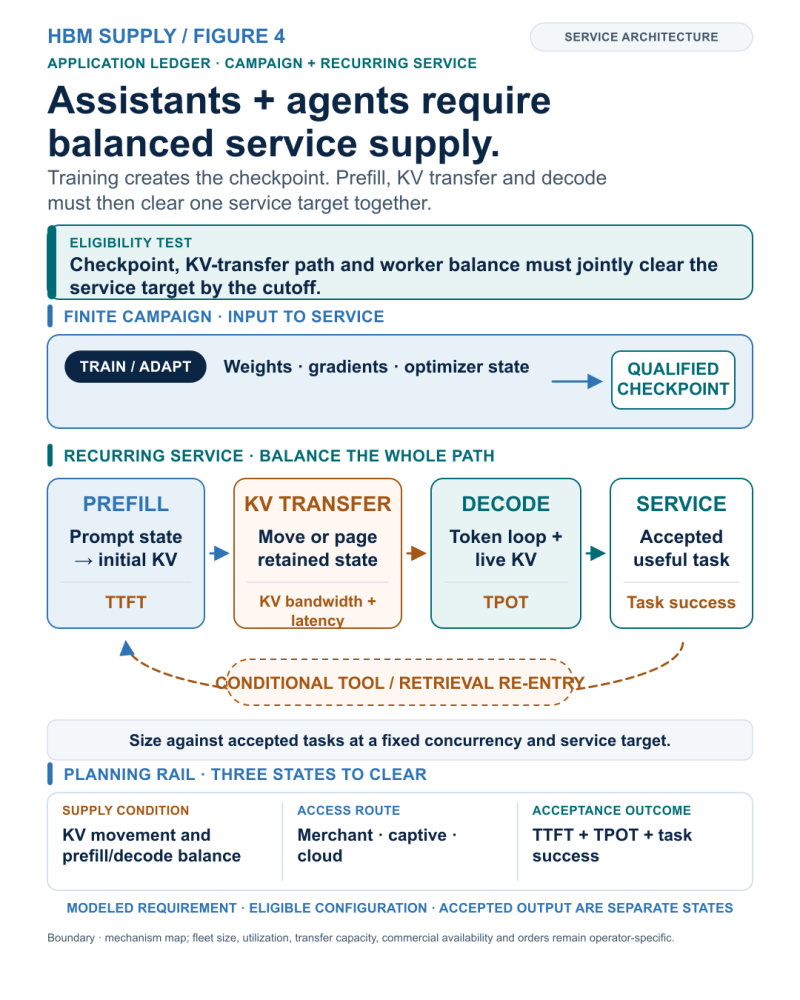
Separate the finite training campaign from the recurring prefill, KV-transfer, decode and service-qualification pipeline, using time to first token, KV-transfer performance, time per output token and task success as distinct checks.
4.2 Recommendation and retrieval
Eligibility test. Eligible supply spans the complete memory hierarchy and meets recall, freshness and p99 latency together.
Meta's SilverTorch places data across GPU HBM, host DRAM and remote DRAM. Retrieval, filtering and reranking must remain inside a sub-100-millisecond budget while updates stream incrementally.[15] The eligible configuration therefore depends on the hot-state working set, sharding, cache hit rate, collectives, recall, freshness and tail latency.
MLCommons' DLRMv3 makes the same systems problem visible in a benchmark: its reference implementation uses a one-terabyte embedding table and distributes dense execution across eight GPUs, while end-to-end p99 latency stays just above 80 milliseconds because batching, data movement and CPU-side overhead still matter.[16] The benchmark specifies workload and topology; merchant supply and fleet volume are unmeasured.
MTIA 300 adds 216 GB of HBM3E to a deliberately co-designed recommendation-training system: twelve integrated 800-gigabit-per-second RDMA interfaces provide 1.2 terabytes per second of total I/O, while a one-to-one CPU-to-accelerator ratio enables optimizer offload.[17] The disclosure covers an internal accelerator and leaves merchant availability undisclosed. The node and communication architecture form the eligible unit; an HBM stack supplies one component.
Training and refresh create publication clocks; serving creates recurring requests. HBM carries the hot tier while host and remote memory hold other state; replication and collectives can multiply it. The practical unit is a qualified result at target recall, freshness and p99 latency. Combine captive, merchant and cloud pools after the workload qualifies them as substitutes.
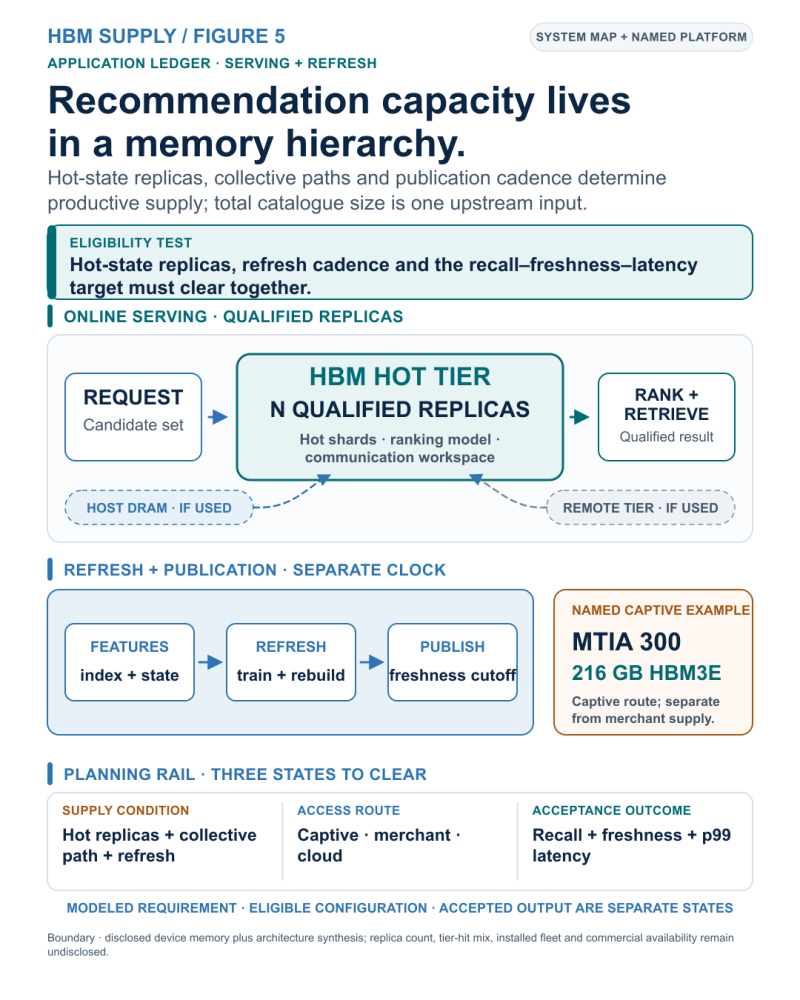
Reconcile the online serving lane with the refresh-and-publication lane across HBM, host DRAM and remote memory.
4.3 Generative media
Eligibility test. A route qualifies when it meets both the output-quality target and the completion deadline, including offload transfer and elapsed-time penalties.
Eligibility changes with model, resolution, frame count, batch, concurrency, precision and deadline. Wan2.2 documents a TI2V-5B route that can run on 24 GB of VRAM with offloading and a faster single-GPU route that recommends at least 80 GB.[18] The same model can therefore create two different, documented eligibility routes and hardware ledgers.
Offload exchanges device-memory relief for host-memory, interconnect and elapsed-time costs. Hugging Face documents how CPU offload can reduce device-memory use yet become
impractically slow, while group offload reduces transfer overhead but requires additional host-memory and interconnect planning.[19]
Quality is also part of admission. MLPerf's SDXL benchmark requires performance and image-quality compliance using FID, CLIP and a human review check.[20] Its thresholds are benchmark rules rather than a production service-level agreement. They show why a lower-memory route must still clear quality and completion time to count as equivalent capacity.
HBM is one of several eligible high-memory routes. NVIDIA's RTX PRO 6000 Blackwell Server Edition pairs 96 GB of ECC GDDR7 with ray-tracing and dedicated encode/decode engines.[21] For a media workflow that clears its quality and deadline tests on that platform, it is a potential alternative configuration, subject to availability and workload qualification. Classify it by the qualified route rather than as reduced HBM supply.
Training and adaptation create campaigns; production creates recurring assets. Device-resident state and concurrency select the accelerator. Owned, reserved and burst routes qualify when quality and elapsed time clear the deadline. Budget against an accepted asset or video minute, with memory fit treated as one condition.
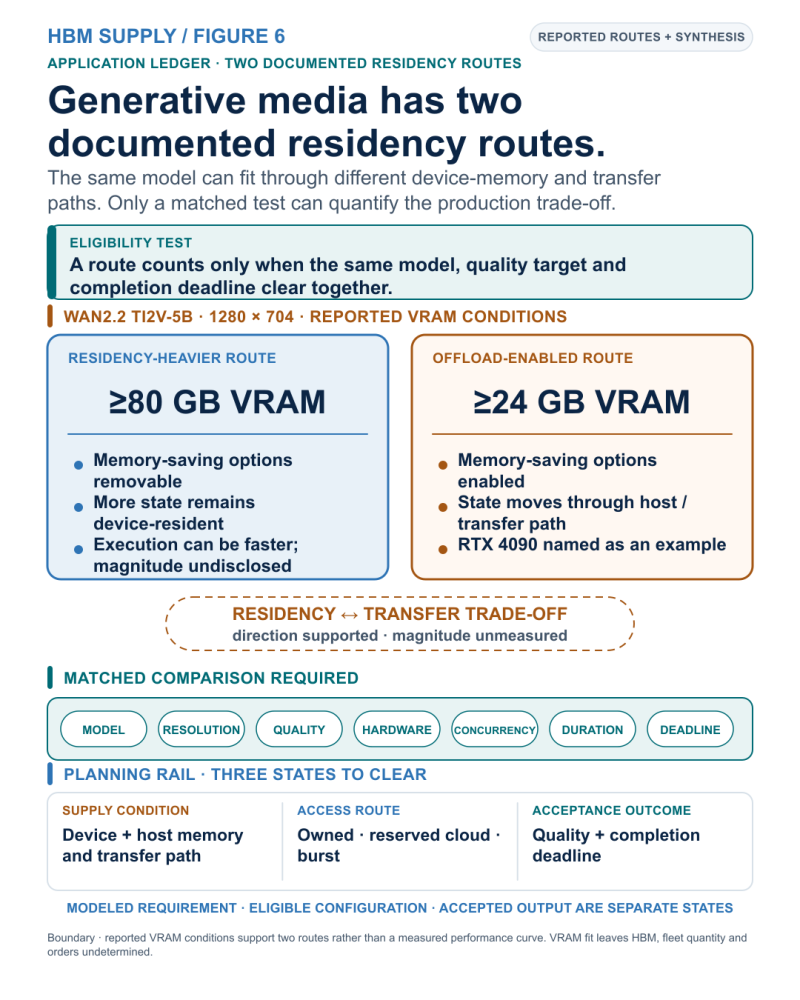
Compare the documented 24 GB offload route with the 80 GB faster route as separate eligibility choices, each subject to quality and completion-time acceptance.
4.4 Physical AI
Eligibility test. The relevant offboard or onboard route qualifies after architecture, sensor, latency, power, safety and product requirements clear.
NVIDIA Isaac Sim 6.0 excludes A100 and H100 because they lack the required real-time ray-tracing cores.[22] Simulation eligibility therefore comes from the complete architecture, including the required graphics capability.
Isaac Sim's published benchmark methodology varies sensor mix, render resolution, VRAM and CPU/GPU balance; observed simulation and sensor rates belong to that complete
configuration.[23] The figures apply to the documented configurations rather than universal robotics requirements. They reinforce the eligibility test: memory, sensors, rendering and end-to-end timing work as one system.
Jetson Thor uses 64 GB or 128 GB of LPDDR5X instead of HBM, plus vision, video and camera interfaces inside a 40- to 130-watt module envelope.[24] Model robot shipments through the endpoint bill of materials; model offboard training and simulation through separate HBM ledgers.
Offboard training, graphics-qualified simulation and onboard execution use different compute, memory and qualification routes. The control loop must pass sensor, latency, software, safety and product tests. Measure cost per validated scenario, qualified update or learning cycle. Maintain separate supply pools for datacenter HBM and endpoint memory because they clear different qualification paths.
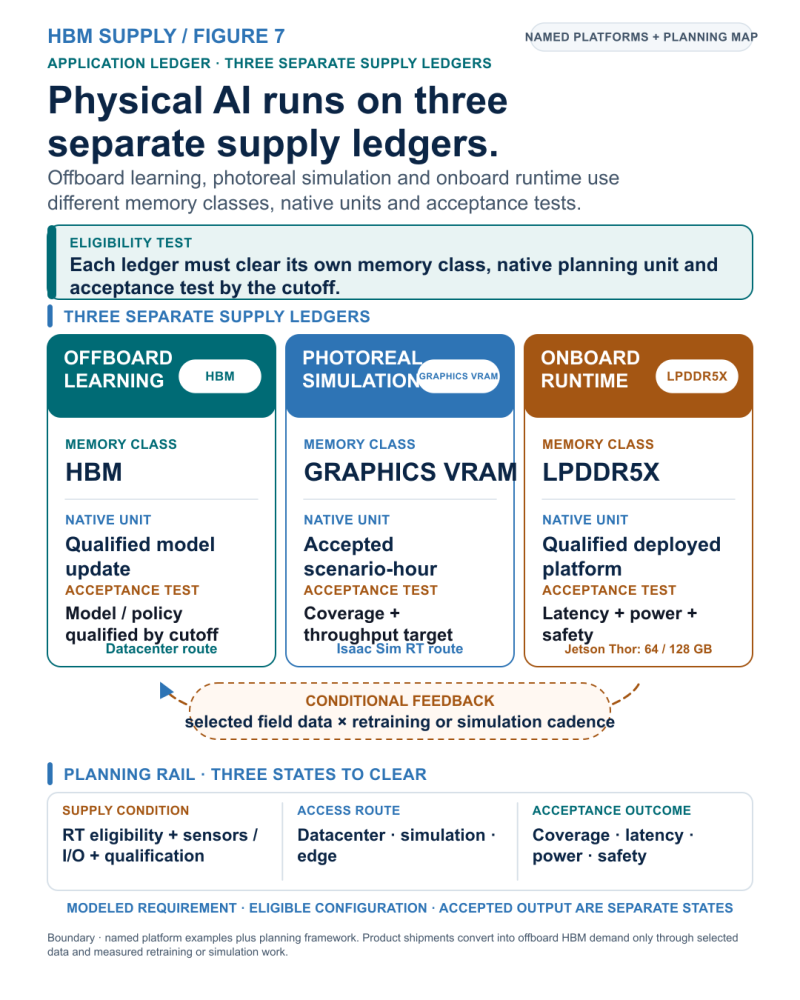
Maintain separate ledgers for offboard HBM training, graphics-qualified simulation and the power-bounded endpoint using LPDDR5X.
4.5 Scientific AI
Eligibility test. Capacity qualifies after precision, per-rank fit, topology, checkpoint path, access window, validation and rollback all clear.
Frontier pairs 512 GB of node HBM with 512 GB of CPU DDR4, while presenting GPU memory as eight 64 GB compute domains.[25] Per-domain placement and interconnect constrain usable node memory.
Operational forecasting adds a deadline and a governance layer. ECMWF's AIFS history records verification, re-dissemination, re-archiving and rollback after a problematic release.[26]
Forecast capacity begins after the service can be validated and recovered inside the operating process.
Campaigns, forecast issuance and discovery loops have different clocks. HBM must work with CPU memory, storage, fabric, precision and checkpoint/restart behavior. Owned, allocated and cloud routes carry different access rules. Count validated outputs completed by deadline, with checkpoint, recovery and rollback readiness included.
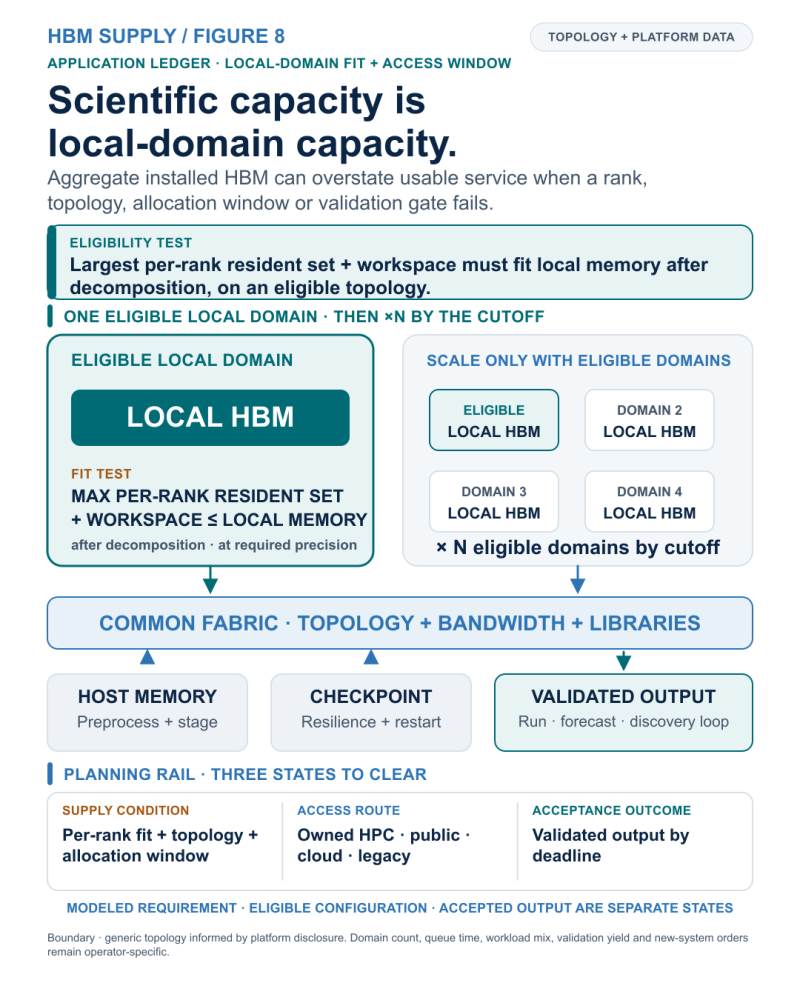
Test whether the maximum per-rank resident set and workspace fit an eligible local HBM domain after decomposition, with fabric and checkpoint paths available by the deadline.
Each lane selects the configuration to test. Memory, logic, packaging and package test define the compatible hardware route; platform qualification and site plus acceptance determine whether it becomes productive capacity. The binding gate moves with yield, allocation, schedule, software, access and acceptance.
The workload has selected the eligible route. The next question is arithmetic: how many complete routes can clear every gate by the cutoff?
5 The accepted equivalent ceiling
How many eligible configurations can clear every gate by the cutoff? Express all six resource budgets in the same unit: accepted equivalents.
5.1 The six gates
For one eligible configuration and planning window, the resource budget covers six gates:
· MEMORY — eligible, supplier-qualified HBM stacks.
· ACCELERATOR LOGIC — compatible, known-good accelerator devices.
· ADVANCED PACKAGING — the required interposer, substrate and assembly route.
· PACKAGE TEST — qualified throughput for the applicable test insertions.
· PLATFORM QUALIFICATION — boards, nodes, racks, fabric and software that pass configuration requirements.
· SITE AND ACCEPTANCE — systems that can be energized, cooled, commissioned and accepted.
Express every budget as accepted equivalents available by the cutoff.
5.2 The minimum-gate rule
Accepted equivalents by cutoff ≤ MIN(Memory, Accelerator logic, Advanced packaging, Package test, Platform qualification, Site + acceptance)
The smallest aligned gate sets the ceiling. Raising another gate creates headroom while accepted output stays fixed.
At the cutoff meeting, the plan shows 130 memory equivalents, 118 logic, 90 packaging, 104 test, 96 platform and 100 site plus acceptance. The ceiling is 90. Everything above that wall is headroom until another gate moves.
Raising packaging from 90 to 110 reveals platform qualification at 96. Twenty additional packaging equivalents therefore raise the modeled ceiling by six.
The decision question is whether relieving a gate creates enough incremental workload-accepted capacity before the cutoff to justify its all-in cost. S&OP establishes configuration, schedule, gate and alternatives; FP&A values timing, premium, exposure and option value; procurement and legal confirm the contract.
Article 1 deducts eligible survivors before this count begins. The minimum-gate rule supplies a planning upper bound. A production forecast also needs inventory, yield, mix, allocation, lead time, compatibility and qualification evidence. The illustration is hypothetical and configuration-specific; delivery outcomes belong in a separate forecast.
5.3 What an acceptance contract looks like
The rule becomes operational when each gate has measurable pass conditions. AMD's MI355X customer-acceptance guide starts with eight accelerators carrying 288 GB of HBM each, then requires at least 3 TB of host memory, eight 400-gigabit backend network interfaces, aligned firmware and AMD's ROCm software stack, single- and multi-node stress tests, and at least 304 GB/s of RCCL all-reduce bandwidth—a cluster-wide collective-communications test—at an 8 GB message size.[27] The numbers apply to that guide and configuration; their strategic value is the pattern. Nominal HBM becomes go-live capacity after the whole platform passes an explicit acceptance contract.
NVIDIA's GB300 cloud-provider guidance likewise separates device presence from network and fabric tests, GPUDirect checks, NVLink and NVSwitch validation, hardware attestation and a 24-hour soak under representative inference load.[28] Many checklist items are strong recommendations with configuration-dependent force. Visible GPUs and HBM reach production capacity after the complete platform clears validation.
5.4 From one ceiling to a stress envelope
One ceiling describes one state. What happens when yield, qualification or the energization date moves? Build a stress envelope.
The rule stays fixed while the resource vector moves. Packaging rework can lower one budget, late characterization another, and an energization slip can make site readiness binding.
Public disclosures stop before a joined distribution for all six gates and their dependencies. Figure 9 therefore uses transparent stress cases. Its 82-to-96 span is an author-defined planning envelope with probability weights left unspecified; actual accepted output can fall below every bound.
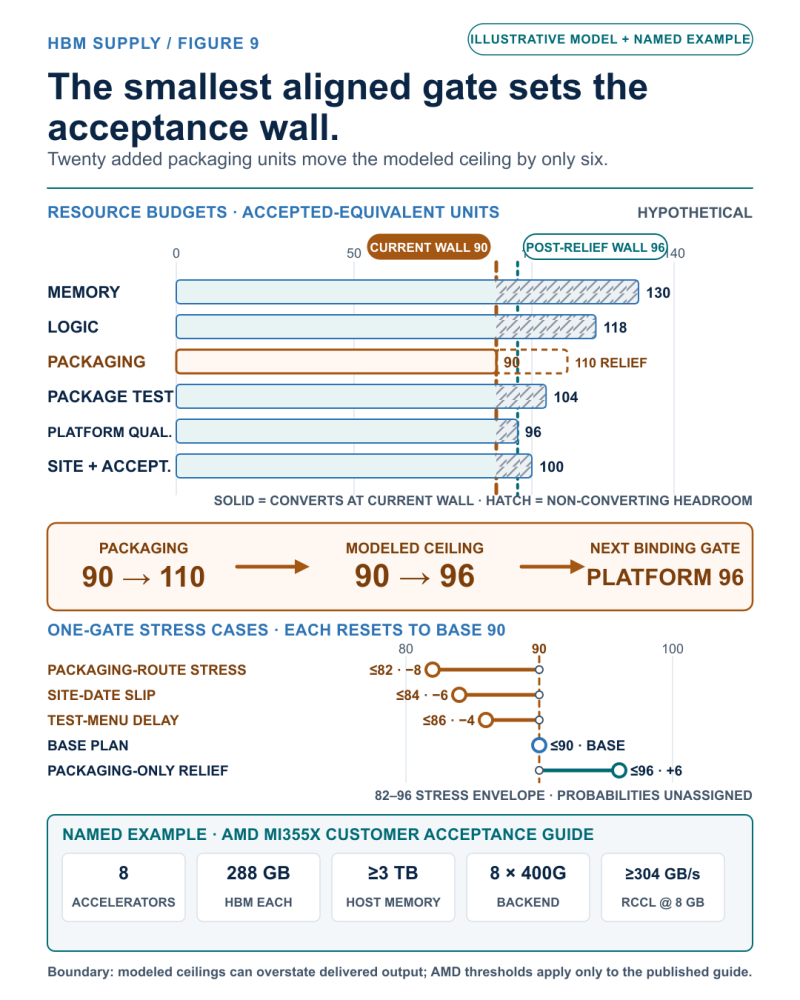
Read the hypothetical acceptance wall at 90, the non-converting headroom above it and the six accepted equivalents gained when packaging rises from 90 to 110 and platform qualification binds at 96.
5.5 Replanning when the window moves
A stress envelope reveals the risk; a control loop assigns the response.
The governed control loop is event-driven: detect → verify → recompute → rank → approve → learn.
When a change breaches tolerance or threatens the date, reopen the workload × configuration × site × cutoff record. Triggers include test menu, yield or rework, qualification, allocation, energization, contract or acceptance changes.
A workable operating model assigns an integrated-capacity team and a named case owner to each record. Infrastructure and workload engineering verify eligibility. Procurement and site operations validate supply and readiness. S&OP recomputes the plan; FP&A prices exposure; named commercial and capital owners approve the change. Software agents can accelerate detection, evidence normalization and route ranking.
Planning software supports constrained multilevel plans and what-if comparison; GPU orchestrators allocate resources inside qualified pools.[29][30] These tool classes support bounded planning and qualified-resource orchestration; named owners retain commercial and capital authority.
1. DETECT — planning platform or agent. Flag a threshold breach from governed supplier, test, qualification, site, contract or workload data.
2. VERIFY — evidence owner. Confirm the evidence state, dimensional key, effective date and accountable owner.
3. RECOMPUTE — integrated-capacity team. Refresh all six gates and the accepted-equivalent stress envelope.
4. RANK — S&OP and FP&A. Compare technically eligible, timely and contractually available actions with exposure attached.
5. APPROVE — named commercial and capital authorities. Apply engineering, workload, finance, procurement and legal controls before changing a configuration, commitment or purchase order.
6. LEARN — case owner. Write the decision, result and revised tolerance back to the ledger.
Where contracts allow, rephase receipts. Accelerate the milestone that sets the ceiling. Qualify any alternate package, test, site or cloud route against its exact requirements before moving work. Re-run the destination lane's eligibility and acceptance checks before redirecting uncommitted systems. Set the response target from the physical or contractual window that still exists.
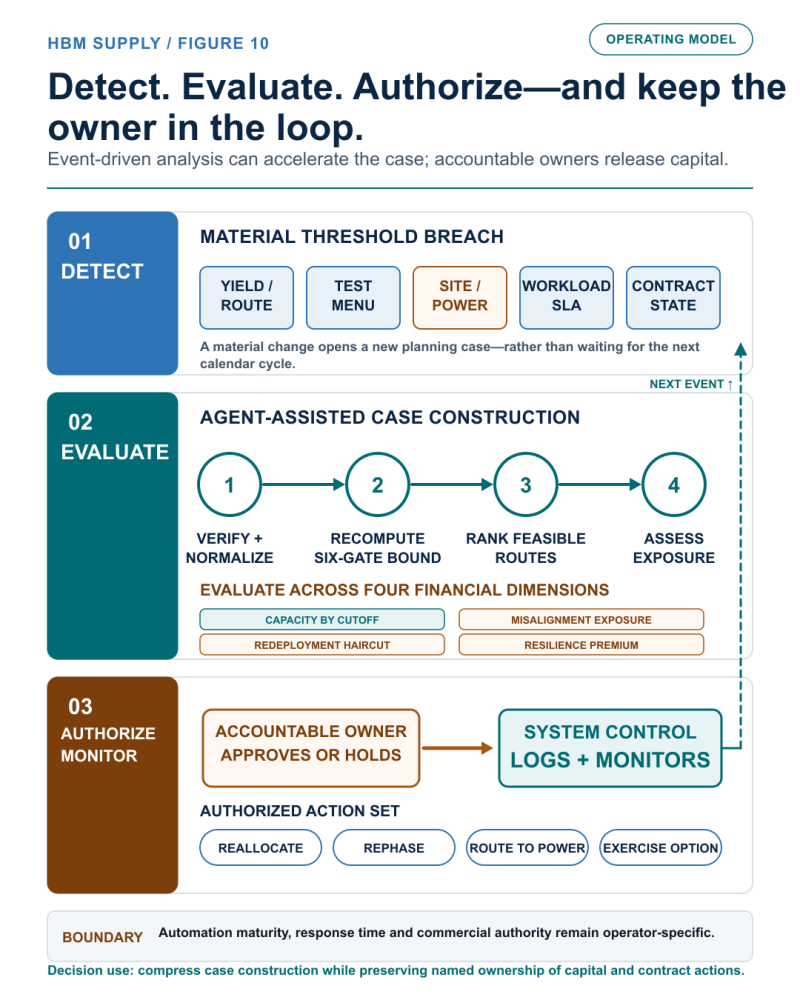
Move a verified threshold breach through three governed bands—detect, evaluate, and authorize plus monitor—until an accountable owner approves or holds the action and system control records and monitors the authorized result.
6 Why qualified supply responds unevenly
Why does headline capacity arrive in uneven increments? Every layer matures on a different clock, while an announcement records one date.
Front-end wafer investment, equipment installation, process learning, stack assembly, package integration, test-program development, customer qualification and site commissioning mature on different schedules. A cleanroom opening precedes equipment and process qualification. Samples precede mass production. Shipment precedes accepted service.
Test illustrates the mismatch. Advantest's July 2026 Q&A described planning forecasts of approximately 18 months, compared with a historical horizon near six months. Yet final visibility into test time and insertion requirements may arrive only after tape-out and characterization, while accelerator final test can be more intensive than CPU test.[31]
Equipment may therefore be committed while the test workload is still uncertain. More testers expand the tool base; program-specific qualification determines usable throughput.
Put construction, equipment delivery and committed capacity on the scheduled clock. Put yield learning, test-menu completion and customer qualification on evidence-dependent clocks. Use ranges and replan triggers for the second group, and treat each announced date as a milestone rather than a capacity guarantee.
The same lag appears in materials. IBIDEN's August update provides the complementary signal. Prospective glass-cloth suppliers improved its procurement outlook, while management still expected demand for large, multilayer substrates to exceed industry supply. Stable Cell 8 production and better use of existing capacity supported stronger-than-planned volume.[32][33]
IBIDEN's statement describes large, high-layer-count substrate conditions. Translating it into HBM-package supply also needs route, allocation and qualification evidence.
Relief is granular. One material input can ease while a substrate class stays constrained; one package route can expand while customer qualification or site power arrives later.
A second route to relief is architectural optionality. JEDEC's July 2026 SPHBM4 standard keeps the HBM4 DRAM dies but changes the interface base die, reducing the host interface from 2,048 to 512 data signals through 4:1 serialization so the memory can be mounted on standard organic substrates rather than a silicon interposer.[34] The standard establishes a consequential architectural alternative; shipment, package qualification and system acceptance come later.
TSMC's July 2026 discussion reinforces the timing distinction: management described alternatives to CoWoS as useful for lowering cost and widening packaging flexibility, while indicating that the glass-substrate alternative discussed in that Q&A still required roughly another year of joint development before production maturity.[35] Alternate-route capacity therefore needs a qualification haircut until its base die, signal integrity, materials, thermals, test flow, customer configuration and cutoff all clear.
This route-maturity constraint explains why the industry is pursuing substrate alternatives while holding them behind a qualification gate. Intel's development program points to flatter, more dimensionally stable glass substrates as a route to tighter overlay and larger, denser packages.[36] That evidence explains the engineering objective. TSMC production maturity, HBM qualification and realized commercial yield need their own evidence.
Supplier ramps provide a third clock, and their state labels require normalization before comparison:
· Micron: high-volume HBM4 shipments for one lead customer platform, qualification samples to multiple other end customers, and HBM4E volume production expected in 2027.[37]
· SK hynix: HBM4 mass shipments reported from Q2, a second-half ramp planned, and HBM4E samples shipped in the first half.[38]
· Samsung: HBM4 mass production and commercial shipment announced in February, followed by scaled HBM4 sales and HBM4E samples to major customers in Q2.[39]
These labels describe different production and commercial states. Public disclosures provide state labels rather than a common customer-qualified-volume denominator. Enter capacity in the plan after confirming product, route, allocation, delivery window and acceptance date.
Generational transitions can increase aggregate HBM output while reducing near-term fungibility. The required HBM generation, interface base die, accelerator, package route, test flow and customer qualification must still align.
Physical relief changes availability first. Contracts decide when that relief reaches price and return.
7 How supply relief reaches prices and returns
Even after physical relief arrives, contracts determine when economics reset.
Physical supply relief reaches prices and margins through repricing exposure, contract structure, product mix, ramp cost, allocation and utilization.
TSMC's own economics show why bottleneck ownership and scarcity-value capture can diverge. Management described backend capacity as constrained while welcoming alternate packaging flexibility because it could enable more customer wafers to flow through TSMC's larger front-end business.[35] Configuration-specific analysis still determines the binding gate.
Micron's strategic customer agreements include binding multiyear take-or-pay volumes. Most use fixed or banded pricing; a minority use market-based pricing. Micron also identifies potential damages for supplier nonperformance, reduced allocation flexibility and possible enforcement disputes.[40]
Micron's June disclosure put signed agreements at approximately 20 percent of DRAM volume over their terms.[41] The agreements cover total DRAM volume. HBM coverage and repricing exposure are undisclosed. The timing gap shows why physical availability can improve before purchase prices reset.
Product transitions further complicate blended numbers. An older configuration can weaken while a higher-priced generation gains mix. Firm prices can coexist with lower margins if ramp cost rises. Consolidated company margins blend HBM with other products, while the return on the next facility requires a separate investment calculation.
Commitments can also accumulate upstream. NVIDIA reported $279 billion of supply and capacity commitments at 26 July 2026, alongside $36 billion of typically six-year AI-cloud service commitments under arrangements in which cloud partners purchase NVIDIA infrastructure.[42] Treat the amounts as separate production-side and consumption-sideobligations. Together they show how securing deployment capacity can create commitments on both sides.
The financing can become gate-specific. In July 2026, Amkor and NVIDIA announced a $1.5 billion multiyear advanced-packaging and development agreement, with an NVIDIA prepayment supporting Arizona capacity that complements Amkor's Asian footprint and aligns the companies' technology roadmaps.[43] The disclosure establishes the financing commitment and intended geographic diversification. Package volume, yield, delivery guarantees and realized concentration-risk reduction are undisclosed. The funding party, gate operator and capacity beneficiary can be different companies; public terms leave the division of scarcity value unresolved.
For the buyer, separate three questions: Has availability improved? Has purchase price fallen? Has commitment flexibility increased?
For the supplier, separate volume, pricing, cost and return on newly invested capital.
Structural HBM bit demand can stay strong while supplier economics normalize. Contracts can also delay price normalization after a physical gate begins to ease.
Those obligations acquire a cost when hardware, power and workload readiness arrive on different dates.
8 Who carries the cost before productive use
8.1 Where physical and contractual exposure accumulates
What does a missed date cost? The answer depends on which obligations have already switched on. Hardware can arrive before the site or workload, leaving payments, inventory and reserved-power obligations active. Depreciation may begin once the asset is ready for its intended use.
The financial clock depends on asset state. Delivered or installed hardware can create cash, inventory, construction-in-progress, reservation or other carrying exposure before depreciation begins. Alphabet classifies data centers and servers under construction or assembly as assets awaiting service, with depreciation beginning when an asset is ready for its intended use.[44] Once in service, depreciation can continue while workload acceptance or utilization stays below plan.
Berkeley Lab's August study examines 55 large-load tariffs and related frameworks, including proposed and approved provisions.[45] Among available standardized terms, minimum contract duration had a five-year median for tariffs proposed before 2025 and a twelve-year median for proposals since 2025. Separately, minimum billing demand had an 80-percent median of contracted demand.
Each statistic uses its own sample: the study reports a median duration and a separate median billing floor. Combining them into one universal twelve-year, 80-percent contract would overstate the evidence. Minimum billing demand sets the billing basis independently of actual electricity consumption.
The operator must reconcile hardware receipts with energization, permitted load ramp, minimum payments, collateral and exit terms. Flexible or staggered connections can sometimes accelerate access through import limits and controls, but the workload must tolerate curtailment and recovery.[46]
For a named site and required date, power is a hard physical gate whose severity varies by location and period. Capacity routing shifts eligible workloads to an already energized region or configuration. Google has described moving suitable media-processing tasks among data centers according to regional hourly carbon-free-energy availability, subject to constraints such as privacy law.[47] The example demonstrates bounded geographic mobility. The destination must also match hardware, data location, latency, reservation, software and acceptance.
Platform acceptance is equally specific. NVIDIA's DGX GB300 NVL72 release notes identify a rack-component firmware baseline for proper NVLink Recovery operation.[48] The evidence establishes a configuration condition; industry-wide qualification rates are undisclosed.
Cloud reservations transfer the asset decision while preserving the matching problem. Google's Ironwood documentation illustrates both architectural and operating-state specificity: each chip's 192 GB of HBM is exposed as two separate 96 GB chiplet domains. JAX and PyTorch are the documented frameworks; TensorFlow falls beyond that route.[49] In All Capacity mode, customers receive full reserved capacity and topology visibility while managing failures and planned maintenance in place of the standard Compute Engine SLA.[50] Ownership changes; acceptance and resilience work continues.
Google Cloud otherwise requires exact reservation-property matching and generally charges while reserved resources exist, including when unused.[51] AWS likewise bills Capacity Reservations whether used or unused, while Capacity Blocks are time- and zone-specific and have separate cancellation rules.[52][53] Access protection and workload readiness occupy separate states.
8.2 Price the misalignment
The following expressions are planning aids; audited accounting follows company-specific policies.
Misalignment exposure = fixed site obligations + reserved-capacity charges + asset carrying costs + qualification or rework costs − recoverable redeployment value.
Model delayed workload value separately because it depends on the operator's revenue, contribution margin and service obligations.
Two delays of equal duration can create different exposure. In an author illustration, normalize committed site and minimum-power cost to five units per quarter, asset carrying exposure to four, and support or remediation to one. A two-quarter package-test delay before hardware receipt produces ten cost units. A two-quarter post-install software-qualification delay produces twenty. These author-defined units show which ledger lines activate as the delay moves downstream; industry estimates and margin forecasts require empirical calibration.
8.3 Haircut redeployment value
Redeployment value needs a liquidity haircut. Start with observable resale, sublease or internal-use value, then deduct for technical eligibility | software/runtime portability | fabric/topology fit | site and power | contractual assignability | requalification time and cost | time to cash. Standard Ethernet can widen technical options even when resale-market evidence is absent; a captive accelerator can retain internal value despite lacking an external exit. When evidence is absent, show a range that includes zero external recovery rather than asserting liquidity.
Recovery value depends on how quickly the configuration can reach another eligible workload, site or buyer after technical, contractual and timing frictions.
8.4 Price the resilience premium
Optionality is contractual and architectural. An operator can layer firm owned or merchant capacity for high-confidence demand, rephasing rights for forecast error, and cloud or on-demand access for the variable tail. Every route still must be eligible and timely. If a take-or-pay commitment and a cloud reservation both bill while unused, duplicated obligations can amplify exposure unless route and timing diversify the same underlying risk. Track each commitment by eligible configuration | firmness | exercise or cancellation right | overlap | billing start | acceptance dependency.
For illustration, a cloud reservation can begin billing to protect a launch date while purchased accelerators await site energization. Both obligations stay live while accepted capacity at that site equals zero.
Resilience premium = all-in cost of the flexible route − all-in cost of the cheapest feasible base route.
Joined probabilities are unavailable, so price the premium by named stress case rather than an expected value:
Scenario resilience value = avoided misalignment exposure + incremental redeployment value − resilience premium − switching and re-qualification cost − duplicated-obligation cost.
In an author illustration, suppose a flexible route costs eight units more, avoids twelve units of misalignment exposure, adds three units of redeployment value and incurs four units of switching, requalification and overlap cost. Scenario resilience value is three units. If the route produces zero accepted equivalents by the cutoff, those three units describe downside protection while current capacity stays unchanged.
Approve the premium only when the route raises accepted equivalents before the cutoff or reduces downside by more than its all-in cost in the stated case. Any protected workload contribution belongs in a separate operator-specific calculation.
The economic unit is therefore workload-accepted capacity and its useful output. An accepted equivalent is the normalized planning unit used to count that capacity consistently; shipments, installed racks and reserved instances occupy separate commercial or physical states.
The formulas price individual cases. The final scorecard decides whether a commitment belongs in the accepted-capacity plan.
9 The decision conditions and executive watchlist
Four operating conditions can coexist across products, contracts and sites.
Scarcity persists. Eligible demand exceeds compatible, timely supply. A premium may be rational when the secured resource raises accepted equivalents before the deadline.
Supply improves under protected pricing. Delivery risk falls, but contract bands or take-or-pay terms delay price relief. Measure the availability gain separately from purchase-price savings.
The configuration gap closes. Exposed prices weaken and buyers should reassess inventory, receipts and uncommitted purchases. New-generation mix can still support blended pricing.
Hardware runs ahead of deployment. Site, platform or workload acceptance is late. Rephase receipts where contracts permit, accelerate the limiting deployment gate and quantify carrying cost. Installed inventory becomes capacity after acceptance.
Use the executive diagnostic card as a non-compensatory control: one red critical gate blocks acceptance, while an averaged score would mask that failure.
· GREEN — matched to the exact configuration and cutoff, supported by current evidence and an accountable owner.
· AMBER — conditional, inside an agreed tolerance or dependent on an open milestone or right.
· RED — missing, mismatched, late, commercially inaccessible or awaiting acceptance.
Ask seven questions. One red critical gate assigns zero accepted-equivalent capacity to that configuration.
1. REQUIREMENT TRACEABILITY — Can every commitment be traced to an Article 1 lane, native unit, exact configuration, site and required date?
2. CONFIGURATION ELIGIBILITY — Has the exact SKU, topology, software route and acceptance test been named?
3. ALIGNED PHYSICAL GATE — Which resource limits the current accepted-equivalent stress ceiling?
4. COMMERCIAL FIRMNESS — Are volume, price, delivery, cancellation and rephasing rights explicit?
5. SITE AND PLATFORM READINESS — Will energization, permitted load, cooling, fabric and qualification clear by the cutoff?
6. DOWNSIDE EXPOSURE — What inventory, minimum billing, reservation, carrying and duplicated-obligation costs turn on if the date slips?
7. REPLAN TRIGGER AND OWNER — What evidence event reopens the plan, within what tolerance, by whose response deadline and under whose approval?
Article 1 produced a modeled hardware requirement. Article 2 asks how many accepted equivalents can clear every gate in the same period—and who carries the cost when the clocks diverge.
Which commitment increases productive capacity by the required date—and who pays if that date slips?
Which of the six gates is creating the most friction in your deployment schedule? Share the gate and the failure mode below.